Antique Fireplaces for a Period House: Choosing a Chimneypiece That Fits the Room
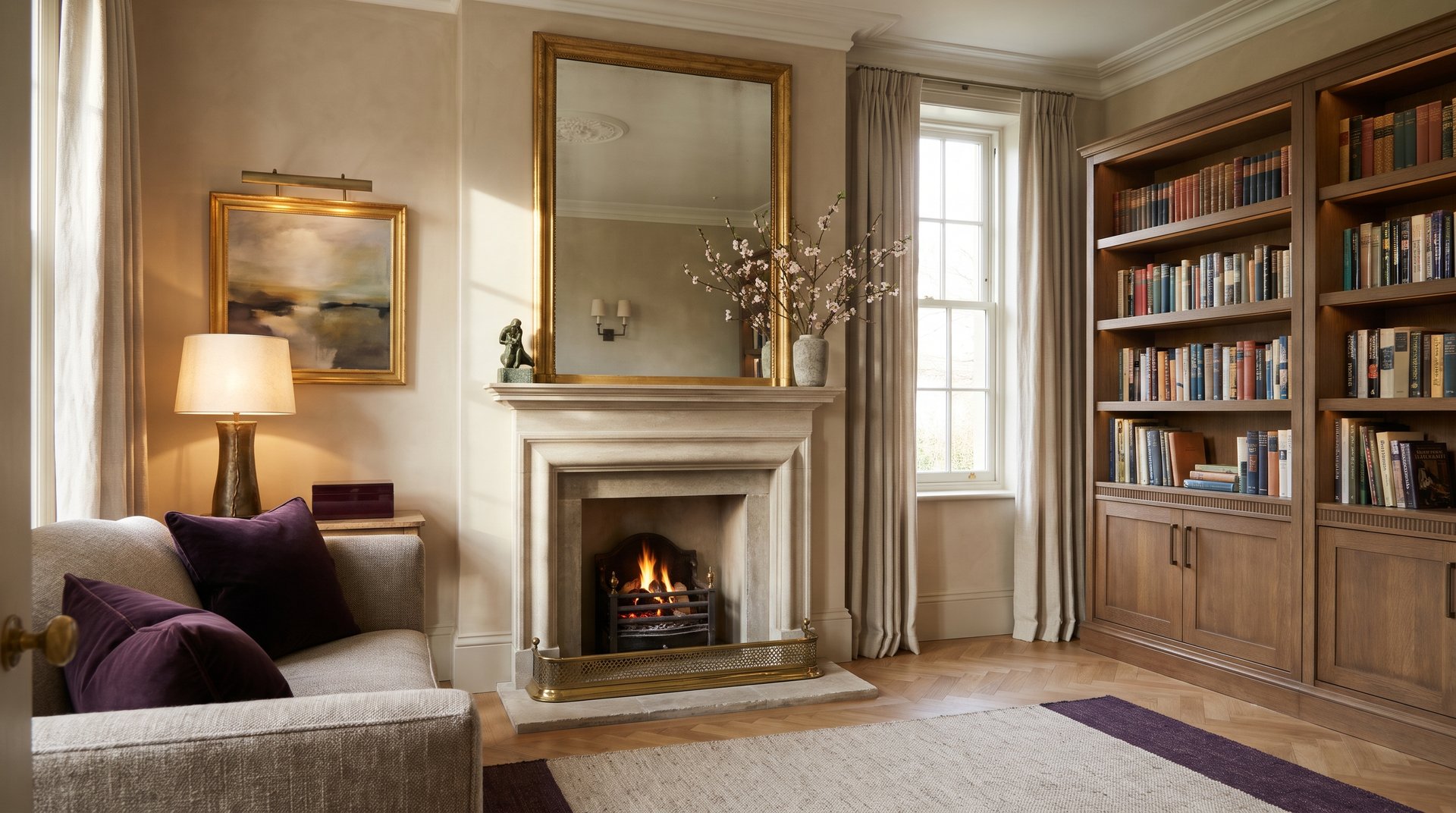
An antique fireplace earns its place when it is chosen for the room it will stand in, not for the date on its label.
The first fire of the autumn changes a house. Chairs turn towards it, lamps are moved, and a room that has been tolerated for months is suddenly the one everyone wants to sit in. That is the moment an antique fireplace either justifies itself or shows up as a mistake: too large for the wall, too delicate for the hall, or beautiful in a dealer’s yard and wrong in the house.
This note looks at how we think about choosing an antique fireplace for a period house: scale first, then material, then the practical business of fitting a chimneypiece into a room it was never made for. It is written from the studio’s experience of restoring houses of historic interest, and where we rely on published guidance we name it.
Antique fireplace scale: start with the room, not the piece
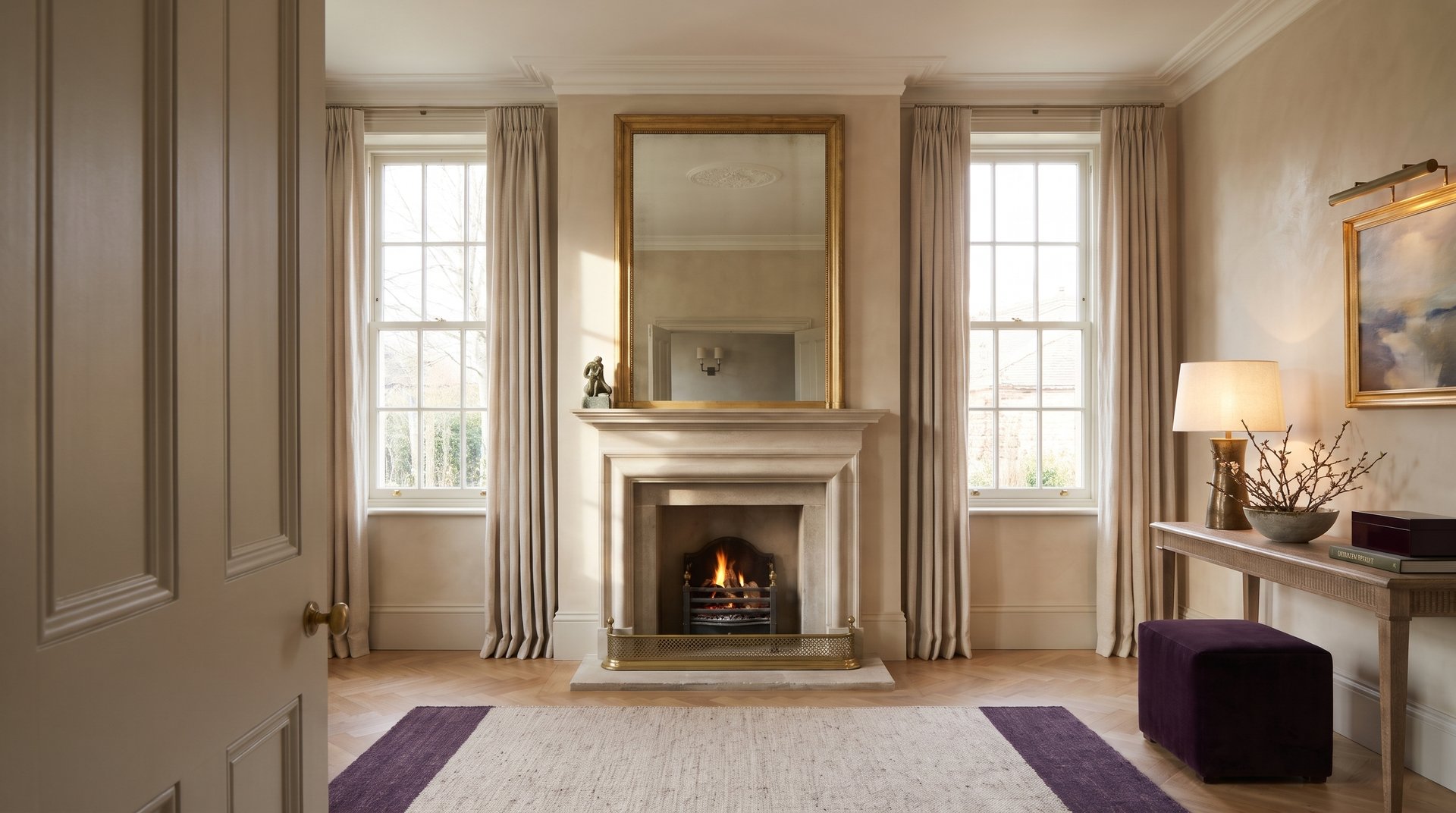
Most poor choices are errors of scale. A grand eighteenth-century chimneypiece in a low-ceilinged morning room overpowers it; a slender Regency surround in a double-height hall disappears. The Victorian Society’s advice on period fireplaces puts the principle plainly: an elaborate, oversized grate will not suit the living room of an artisan’s cottage. The same is true at the other end of the scale.
We begin with three measurements of the room, and none of them is the opening. The first is the height from floor to cornice, which decides how tall the chimneypiece and any overmantel can be before they crowd the ceiling. The second is the width of the chimneybreast, which should be wider than the chimneypiece with some wall visible on either side. The third is what will hang above: a mirror or a picture changes the proportions of the whole wall. This is studio judgement, not a rule.
A paper template cut to the outline of a candidate chimneypiece and taped to the wall, seen at the time of day the room is used, tells you more than a photograph.
Stone, marble and timber: reading the material
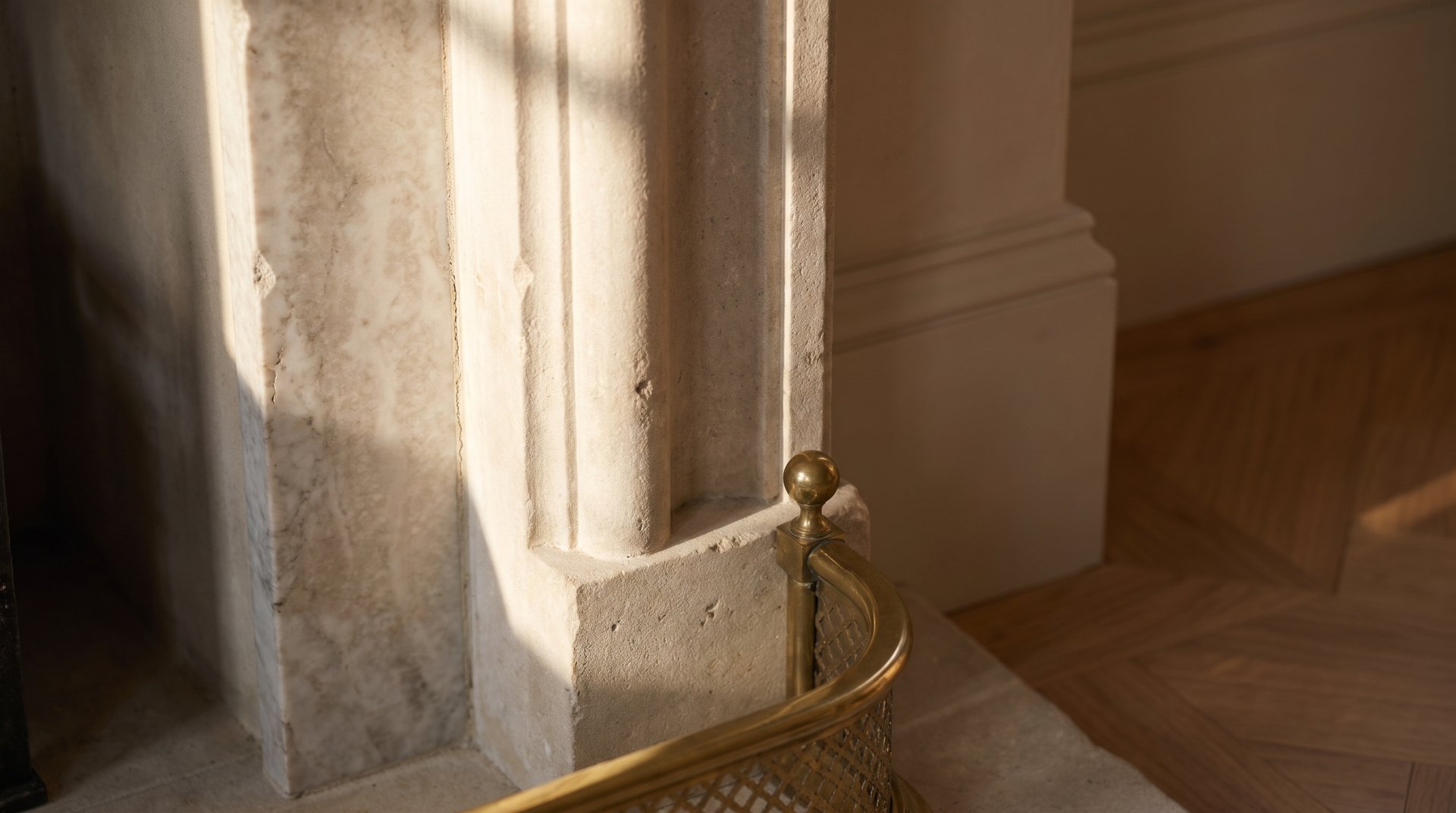
In our experience an antique chimneypiece is made of what its period and its budget allowed: carved timber and plaster in Georgian and earlier houses of a certain standing, limestone and sandstone in halls and country rooms, and marble, in its many kinds, from restrained Georgian surrounds to the more elaborate pieces of the later nineteenth century. Country Life’s interiors editor, Giles Kime, in a 2017 list of specialist makers and dealers, notes that the trade covers bespoke and cast stone, marble, and antique and reclaimed pieces, which is a useful reminder that the label on a piece deserves a question.
The questions we ask are practical. Is the piece carved from a single block or assembled? Has it been repaired, and in what? Is the colour and patina consistent, or has one part been cleaned and another left? Marble that has been restored badly is hard to hide in raking light, and a surround that has been cut down to fit a narrower opening has usually lost something in its proportions.
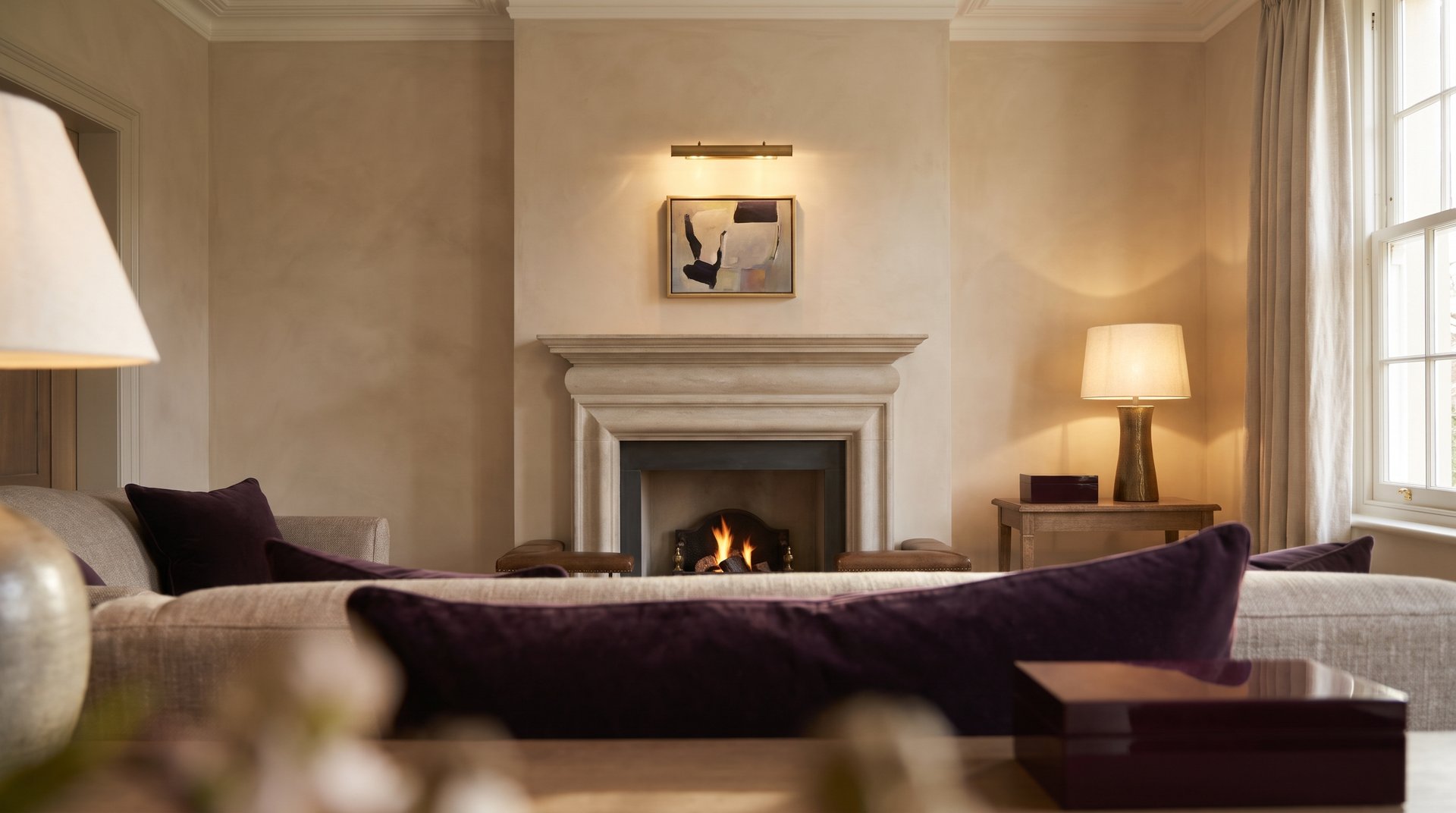
Material also has to agree with its room. A pale limestone chimneypiece sits well against limewashed or polished plaster walls and a stone floor. Figured marble wants a calmer wall, and a carved timber surround wants a room with enough height and panelling to carry it. We write more about how surfaces age together in our work on interiors.
Fitting a chimneypiece into a room it was not made for
Few antique pieces go into the house they came from. The craft lies in making the join look as though it was always there. The Victorian Society suggests that the best guide to a missing surround is an original from a neighbouring house of similar age and date, and that shadowy lines in the plaster of the chimneybreast can show the size of the one that has gone. We would add the floor to that list: the hearth slab, the skirting and the plaster return all need to be read before anything is bought.
In practice that means measuring the opening and the breast, and being prepared to adapt the surroundings rather than the piece. A good mason can re-cut a hearth, a plasterer can reform the return, and a joiner can adjust a skirting block, all in the same materials as the house. What we avoid is shaving the antique itself to suit a modern opening. Where a chimneypiece is being restored as well as fitted, the specialist who does it should be named in the drawings, and their fixing method agreed before the piece leaves the workshop.

The flue, the hearth and what a listed interior asks first
Behind every fireplace is a chimney, and a handsome surround is no use if the flue cannot be trusted. Historic England’s advice on changing a fireplace notes that unblocked flues help ventilate a house and that blocked ones can lead to damp. It advises keeping the hearth slab for any live fire, since it protects floors from burning fragments, and it suggests that any new grate should be a reversible installation, so that it can be undone without damaging the building. The Victorian Society recommends that a chimney be cleaned and inspected by a sweep before an old fireplace is used again.
The building regulations come into this too. Approved Document J, the government’s statutory guidance for England on combustion appliances, covers hearths, fireplaces, flues and chimneys, and its 2022 amendments extended the carbon monoxide alarm provisions. We would not rely on our own reading of it. A chimney sweep or a qualified engineer should confirm what a particular flue needs, and the building control body should be asked how the guidance applies to your house.
If the house is listed, the first question is not which chimneypiece but whether the existing one may be touched. Historic England says that listed building consent may be needed to remove or alter a fireplace, and that chimneypieces are often original or have been altered over time to suit later tastes. Find out what is significant in the house before you take anything out or put anything in. Our earlier piece on heating a listed building covers how that conversation with the conservation officer tends to run, and the true cost of a Grade II listed renovation sets out the consent process in more detail.

Where the fire sits in the evening
A fireplace is the centre of a room only if the room is arranged for it. We place seating so that two or three people can sit near the fire without their backs to the door, keep the surround clear enough that its carving can be seen, and light the wall above so that the chimneypiece reads at night as well as by day. Lamps rather than overhead light, and a picture light or a pair of wall lights behind the fire, make the difference between a hearth people walk past and one they gather at.
Choose the fireplace for how the room will be used on an ordinary evening in February, rather than for how it photographs. It is a lesson the families we work with often repeat. A house kept for the long term rewards pieces that improve with age, and a good chimneypiece is one of them.
We looked at a related question, how a room is made welcoming from a blank canvas, in Challenge No. 10, and the fireplace trade itself was discussed by Nicholas Chesney in an earlier Q&A on the Journal. If you are weighing the purchase of a period house and want to know what its fireplaces, flues and listing will ask of you, Clarity, our pre-purchase appraisal service, is where that conversation starts.
This article is general information, not planning, building regulations or engineering advice. Listed building consent and the requirements for any flue or hearth should be confirmed with the local planning authority, the building control body and a qualified chimney sweep or engineer.