Home Library Design: A Room for Books, Quiet and the Long Evening
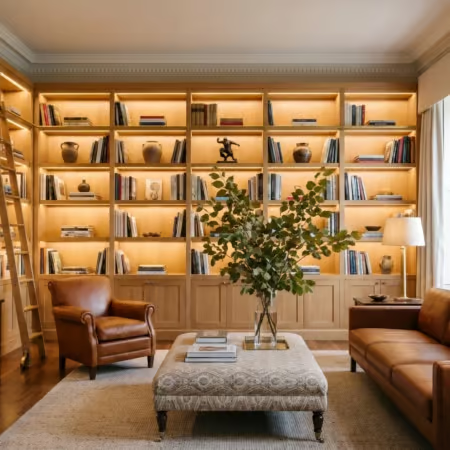
A library earns its place in a family house by being the room where the house goes quiet: built for the books, lit for the evening and kept in the right air.
Good home library design begins with a question that has little to do with shelving: who will use the room, and when? In the houses we know best, the library is rarely a grand showpiece. It is the quiet room, where one person reads, another works through the evening post, and the telephone and the television are not invited.
Janine Stone & Co. has designed homes for private clients since 1987, and in our experience the rooms that last are drawn around a habit rather than an image. A library is the clearest example of how our interior design work starts with the way a family lives. What follows is how we think about it: the books first, then the light, the quiet, the air and, in an older house, the consents. For an earlier look at a sitting room with a library, see this Journal note.
Start with the books, then draw the shelves
Before any joinery is drawn, we ask what the shelves must hold. A reader’s paperbacks and a collector’s folios, atlases and bound journals make different demands. Folios need deep, sturdy shelves; tall volumes need headroom that standard bays do not give; a working collection needs reach and a logical order more than beauty. Measuring the books, or at least sampling them, is the least glamorous and most useful step in the whole commission.
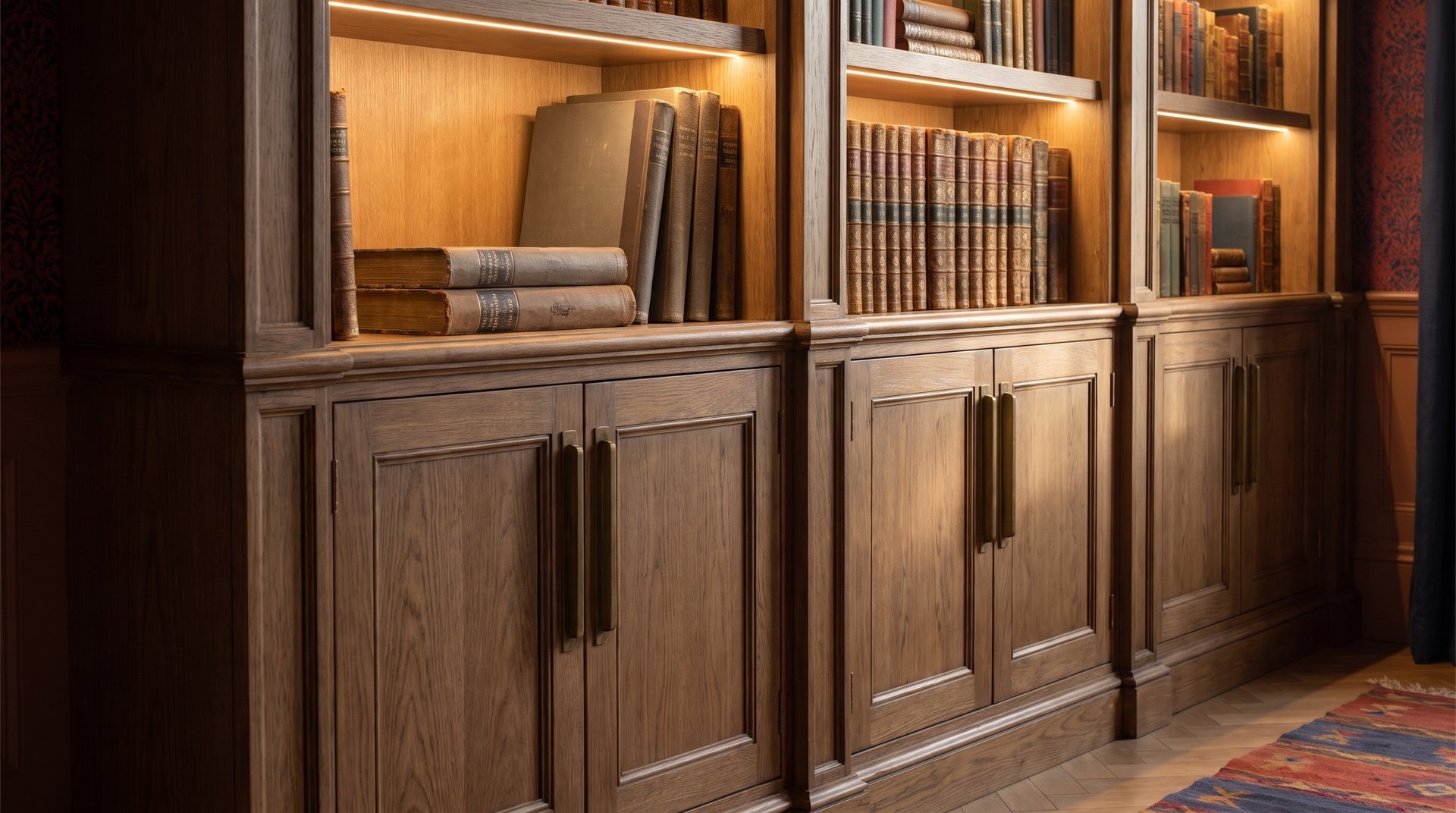
Library joinery should read as substantial and made: thick shelves with a visible front edge, deep rails and stiles, a profile that catches the light, and a grain that runs on from one bay to the next. Thin shelves bow under a row of art books and look it long before they fail. Where one wall is given to books, we usually leave another calm, so the eye has somewhere to rest.
Leave room to grow. A library that is full on the day it is finished has already failed. We plan spare capacity from the start, because collections nearly always keep growing.
Light for reading, and light that spares the paper
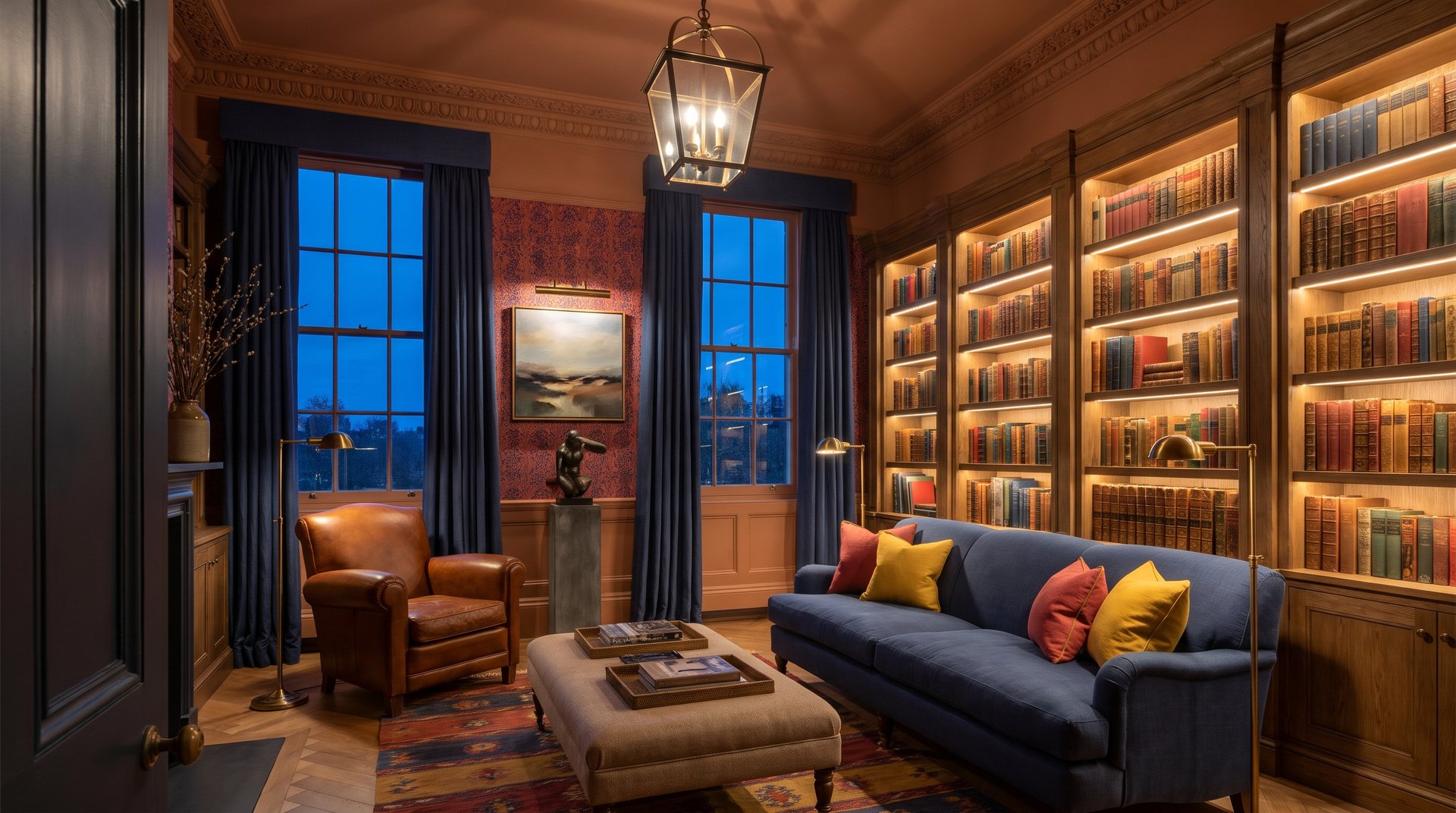
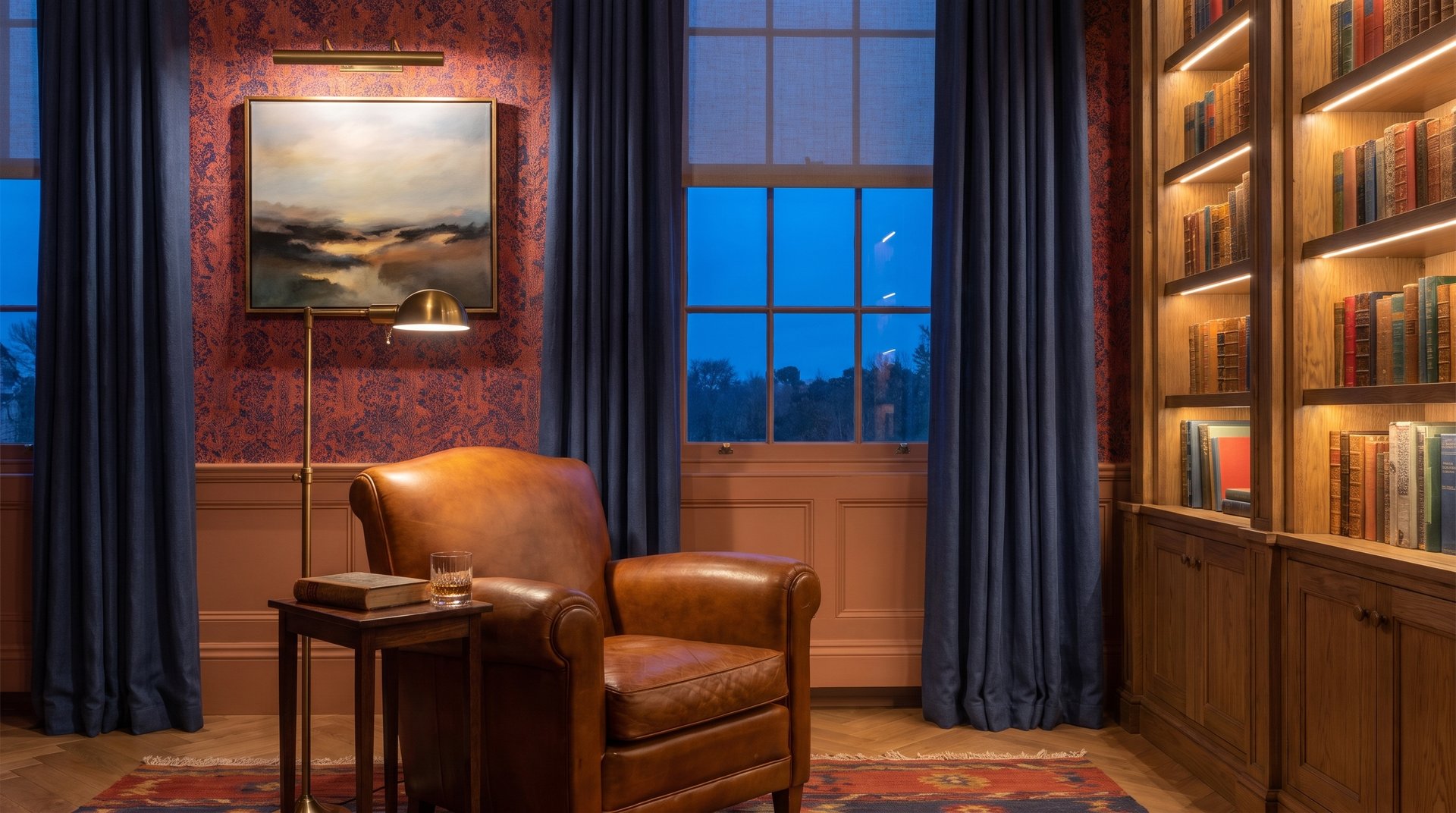
A library is lit in layers, as every room people actually live in should be: a lamp at each reading chair, a picture light on the principal painting, a soft glow along the shelves, and daylight that is controlled rather than shut out. Overhead light alone flattens the room and leaves the spines in shadow.
Light is also the quiet enemy of a collection. The National Trust’s guidance on caring for paper and books advises monitoring cumulative light and controlling it with UV filters, blinds, shutters or curtains. In practice that means lined curtains or linen blinds at the windows that take the sun, filtered glazing where the house allows it, and no best volumes on a shelf where a south-facing window will fade the spines year after year. Our note on natural light in a period home sets out how we think about daylight more widely.
Quiet is designed in, not hoped for
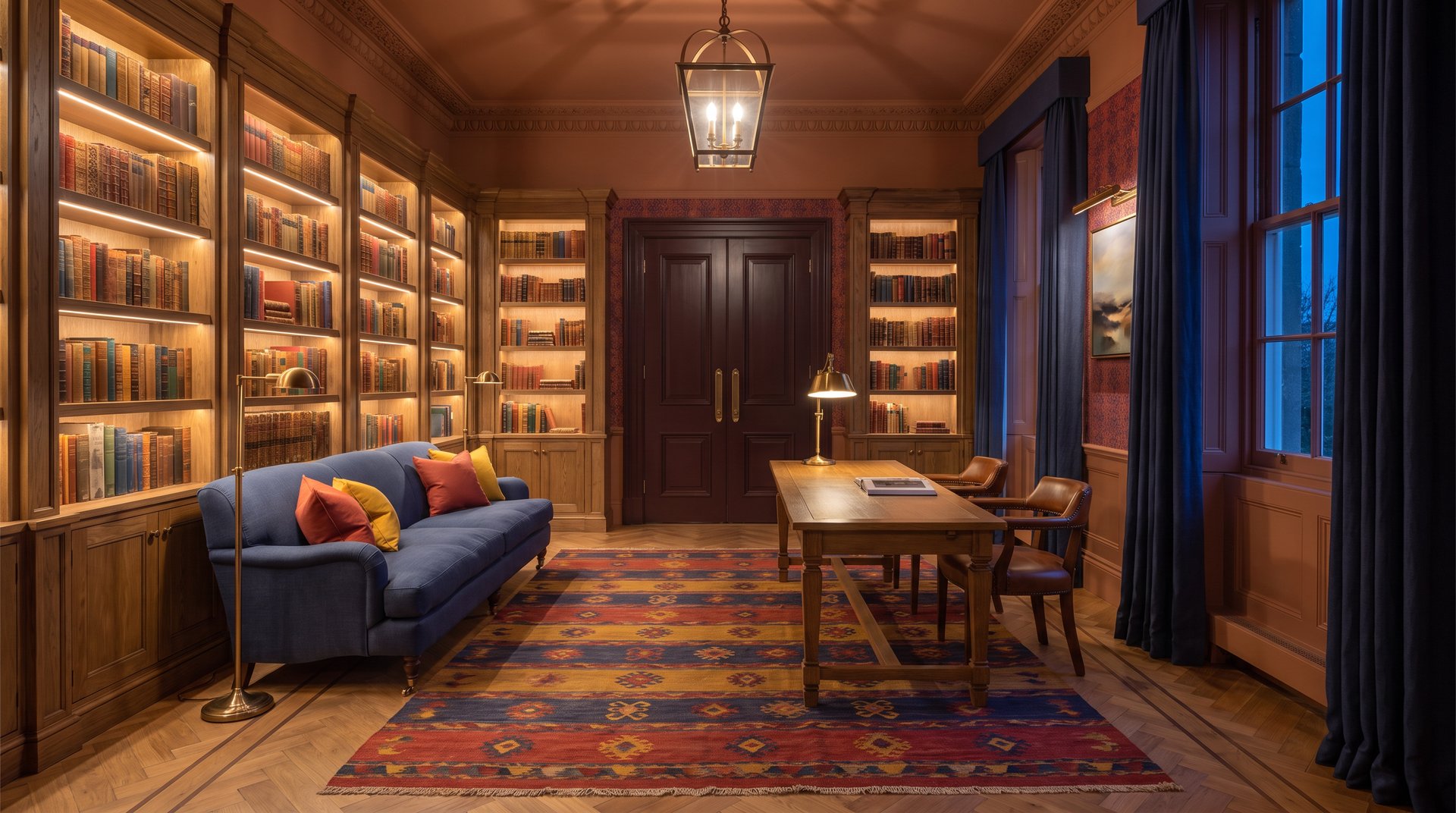
A library’s real luxury is silence, and silence is made from ordinary things put together with care: a solid door that closes properly, a thick rug over a well-laid floor, lined curtains, upholstered seating and, not least, the books themselves, which in our experience soften a room considerably. Position matters more than any later fix. Where we can, the library sits away from the kitchen, the stairs and the media room.
Where a library must sit beside a noisy room, the wall and floor build-up should be decided with the architect before the walls are closed. That is the moment to ask, and it costs far less than asking afterwards. It is also where one accountable team for design and project management earns its keep: the door, the floor, the lighting and the shelving are decided together, not one after another.
Air, damp and the weight of paper
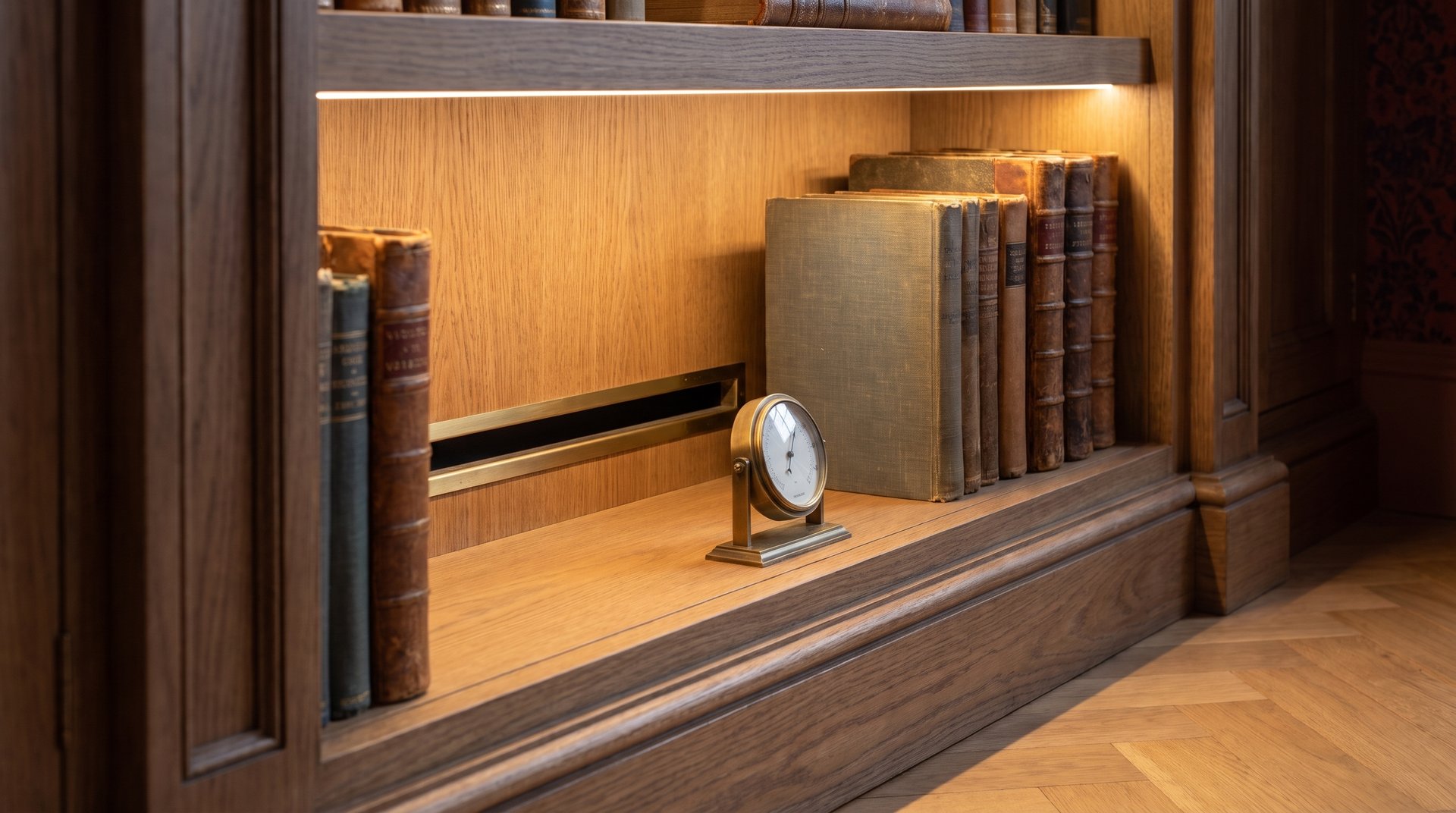
Books are paper, glue and leather, and they respond to the room. The National Trust’s guidance puts the ideal relative humidity for paper and books at 40 to 65 per cent, and warns that above 65 per cent paper softens and mould is encouraged. A cold external wall, an unheated room or a radiator working hard beneath a shelf can each push a library out of that range. We keep shelving off cold walls where we can, and we ask the engineer to heat the room gently and evenly, never hot.
The same guidance suggests moving books forward on the shelf so that air can pass behind them, and, where possible, ventilating the back of the bookcase. We build that detail in from the start. Bookcases are also heavier than they look: a full wall of books concentrates a great deal of weight along one line, and in an older house with timber floors we ask a structural engineer to check the floor before the joiner is instructed.
Home library design in a listed or historic house
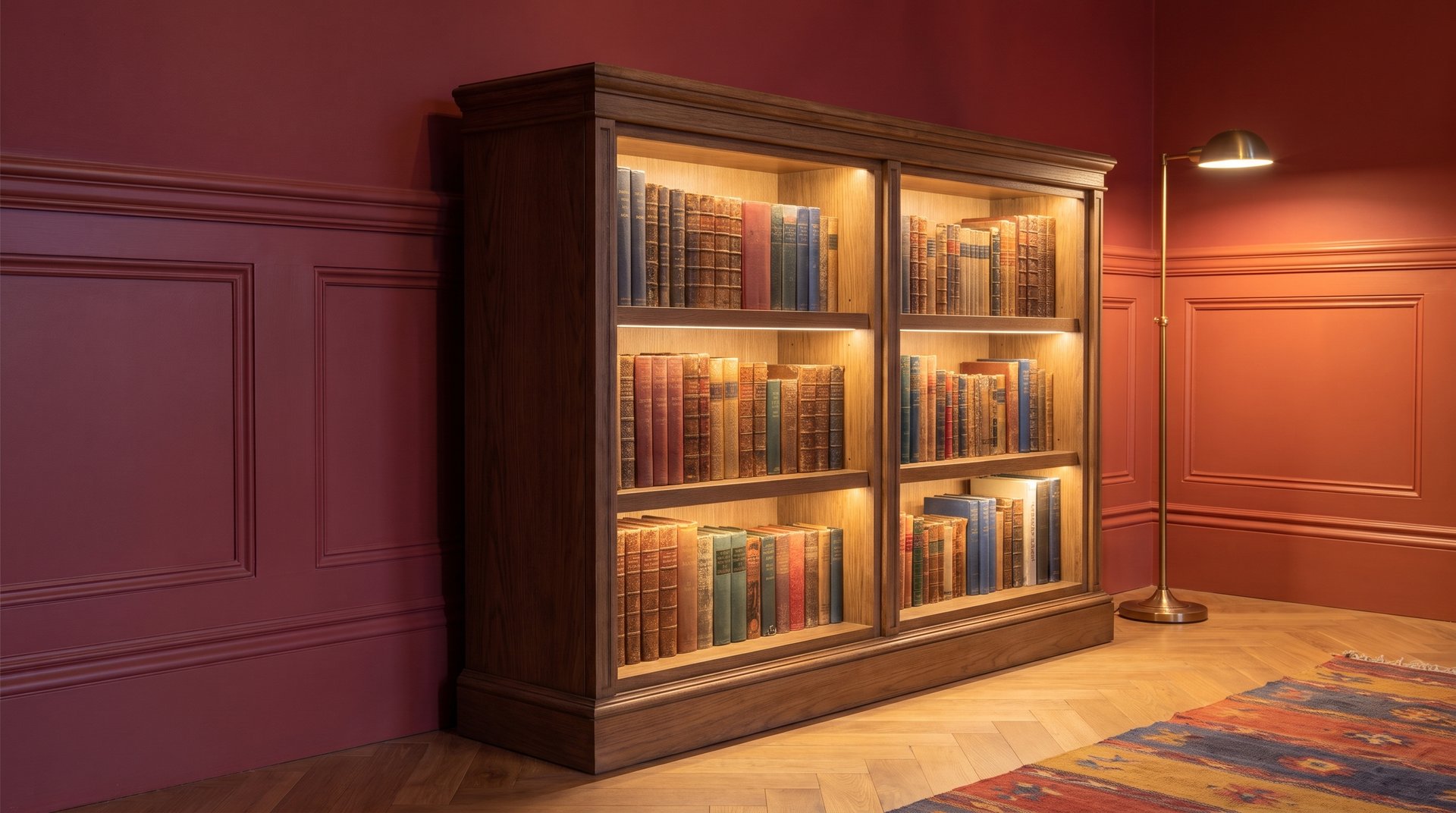
Many of the houses we work in are old, and some are listed. Historic England’s guidance is that listed building consent is needed for works that affect a listed building’s character or appearance, and it advises speaking to the local authority’s conservation officer first. Shelving fixed to panelling or plaster, or built into an original recess, can affect that character. A free-standing bookcase, set a little clear of the wall, is often the gentler route. We put the question to the conservation officer rather than assume the answer.
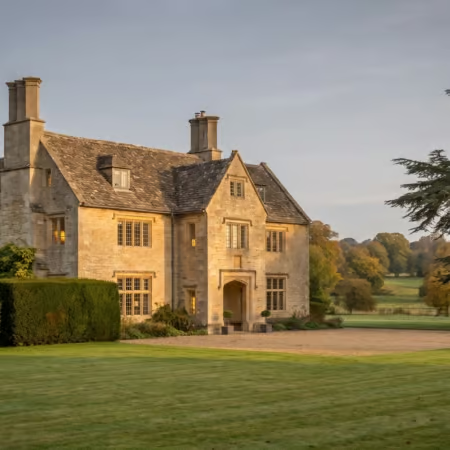
Janine Stone & Co. restores houses of historic interest and listed properties, and designs new homes, and the principle is the same in both: the room should look as though it had always been there. The best libraries we know are plain in intention: books within reach, a good light, a door that closes. Everything else is detail. For how a quiet room sits within the rhythm of a whole house, see our piece on a weekend of twenty and a Tuesday for two.
This article is general information, not legal or planning advice. Consent requirements depend on the individual building; speak to your local authority’s conservation officer and a qualified adviser.