The Wall You Share: Party Walls in Super-Prime London
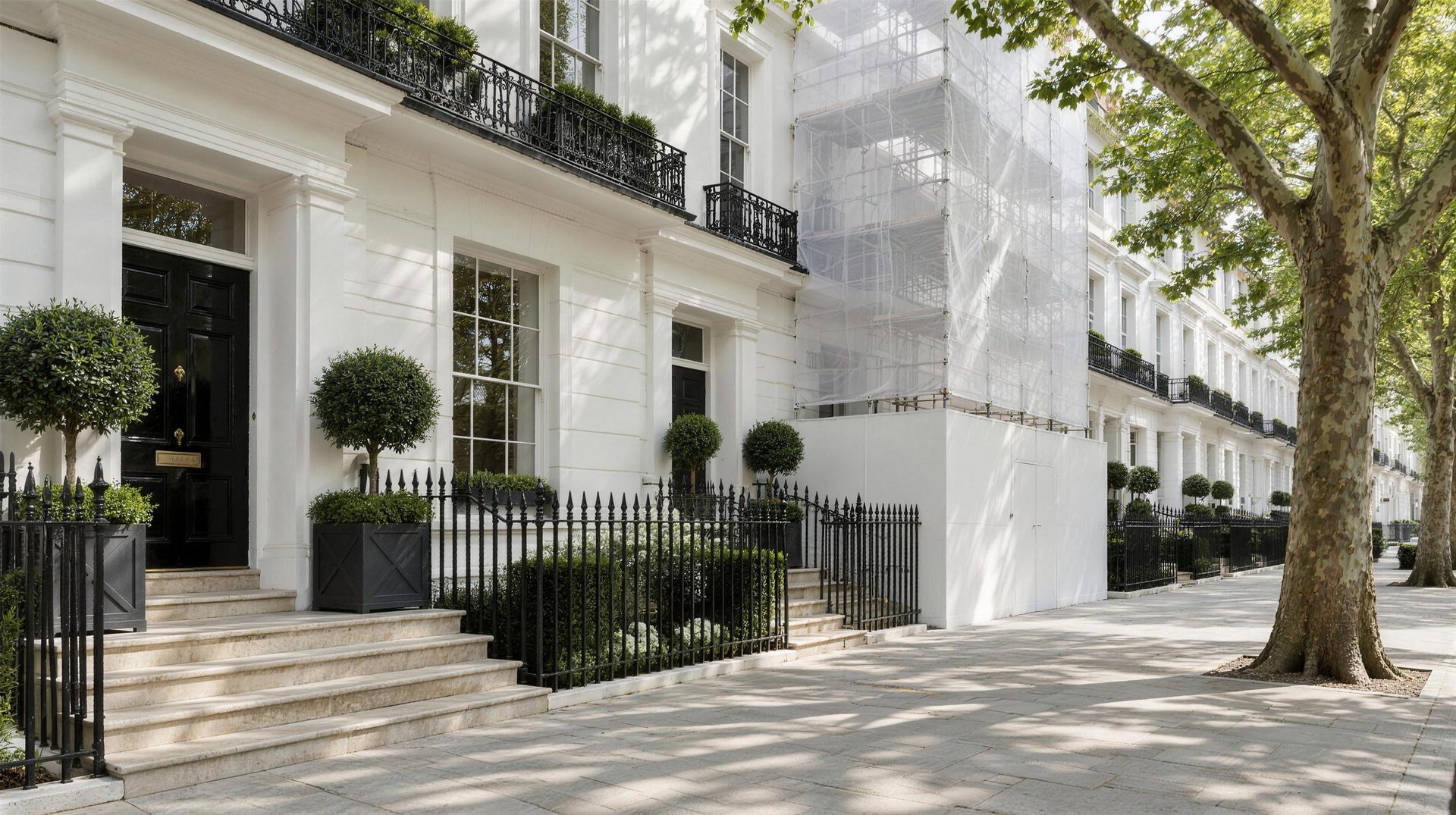
The Party Wall Act is the most procedural part of any London renovation. It is also, in our experience, where a project’s reputation on the street is made or lost.
In the terraces and squares of Belgravia, Mayfair and Kensington, almost every great house shares a wall with someone. We have been working behind those walls since Janine and I founded the practice in 1987, and one lesson has held true throughout. The law of party walls is the easy part. The neighbour is the real matter.
On these streets, the house next door belongs to someone who is used to being consulted. They will have a family office, a surveyor, very often a lawyer, and sometimes a security team with its own views on scaffolding. They cannot stop you exercising your rights under the Act, but they can shape how and when the work is done. Whether that influence becomes a partnership or a siege depends almost entirely on the first conversation.
The law, briefly
The Party Wall etc. Act 1996 applies to three kinds of work: building on or up to the boundary, working on a shared wall, and excavating near a neighbour’s foundations.
The notice periods differ. Work to an existing party wall needs at least two months’ notice. A new wall at the boundary, or excavation within 3 or 6 metres of a neighbour’s foundations, needs one month. If a neighbour doesn’t consent in writing within 14 days, a dispute is deemed to have arisen and surveyors take over.
You’ll read in 2026 that the Act has been overhauled. It hasn’t. Its only amendment is the Electronic Communications Order of 2016, which allows notices to be served by email where the recipient agrees. The official GOV.UK explanatory booklet remains the clearest plain-English summary. Every surveyor worth appointing knows it by heart.
What the booklet can’t do is repair a relationship that began with a letter.
We knock before we serve
Our firm rule is that the formal notice should never be the first a neighbour hears of our client’s plans. Even the government’s own guidance says it is best to discuss the work fully with adjoining owners before giving notice. On a super-prime street, we would go further.
Before anything is served, we ask to meet the neighbour’s household or their office, with drawings in hand. We explain what is being built and why, how long the noisy phases will last, what the façade will look like while it is wrapped, and who to call, at any hour, if something concerns them. A neighbour who has seen the section drawings over coffee will read the notice as confirmation. A neighbour who hasn’t will pass it straight to their lawyer, and our guide sets out what happens when a neighbour objects.
Picture a basement planned beneath a house on a Belgravia garden square. Before any notice goes in the post, the family office next door is invited for coffee and a look at the section drawings. In that conversation it emerges that the neighbours’ daughter is to be married from the house that summer. The noisiest phase of the excavation moves by six weeks, and when the notice arrives, it is countersigned within days. It is a small courtesy, and on these streets it is exactly the kind that decides how a project is remembered.

One surveyor, or two
The Act allows neighbours to share an “Agreed Surveyor”, or to appoint one each, with a third selected to settle anything the two cannot. Whichever route is taken, the surveyors must act impartially rather than as advocates.
An agreed surveyor is quicker and cheaper, and it is right for modest works between neighbours who know each other well. Where the adjoining owner has advisers of their own, as they almost always do in Mayfair or Belgravia, our advice is to expect two surveyors and to plan the programme accordingly. Trying to insist on one only tends to delay the moment when both sides are properly represented.
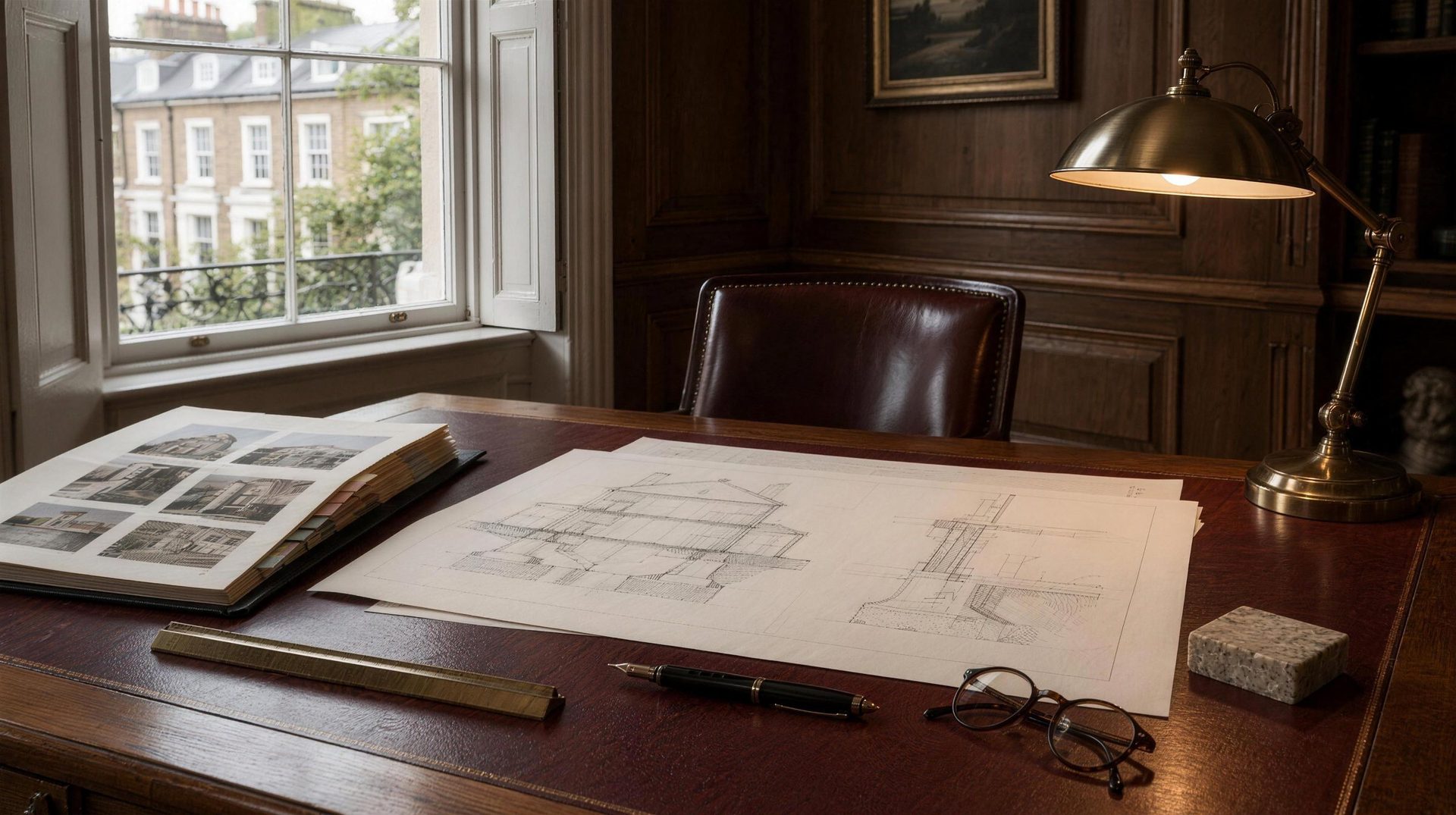
The schedule of condition deserves a curator’s eye
Before work begins, the surveyors usually record the condition of the neighbouring house. The Act doesn’t strictly require this, but without it, attributing later damage becomes very difficult.
In prime London, the house next door may hold finishes as fine as anything we are creating for our client: hand-painted silk wall coverings, water-gilded cornices, a polished plaster that took a craftsman weeks, a collection hung salon-style on a party wall. A schedule of condition written for a suburban semi won’t do. It should be photographed in raking light, room by room, with specialist finishes identified by name. Both sides should hold a copy, and both should have agreed it before the first hammer lands.

The building owner usually pays the surveyors’ fees where the works are solely for their benefit. Adjoining owners can also ask for security for expenses before work starts. On a deep basement, we would rather offer that security than be asked for it. It costs little, and it says a great deal about how the project intends to behave.
Where party walls really cost money
The expensive party wall problems are rarely legal. They are problems of programme.
If work starts without proper notice, the neighbour can seek an injunction. On a project with hand-made joinery already months into production in the workshops, and specialist trades booked in sequence, even a few weeks’ pause compounds quickly.

This is why party wall matters are never a separate hurdle in our projects. In prime central London, a single house can be running four processes at once: planning, listed building consent, a great estate’s licence for alterations, and the party wall process. Each has its own timetable and each can hold up the others.
Janine and I brought architecture, interior design and construction under one roof precisely so that processes like these run as a single programme, with each discipline taking contractual responsibility for its part. The party wall surveyor is briefed when the structural design is fixed, not when the site team is waiting at the gate. Our construction management and basement extension teams work to that principle on every house.
If you are buying
A party wall history travels with a house. Property information forms completed during conveyancing may ask whether there has been a notice or dispute under the Act.
For buyers planning significant works, the more important question is what your ambitions will require of the neighbours, and how they are likely to respond. Our Clarity pre-purchase service, used by private buyers and by buying agents acting for them, is designed to answer questions like this before exchange rather than after.
The same standard, next door
Our promise to clients has always been that every project will be exceptional without exception. In a terrace, that promise doesn’t stop at the party wall. The way a house is built says as much about its owner as the way it is finished, and the neighbours will remember the first long after they’ve forgotten the second.
This article is general guidance, not legal advice. For specific works, appoint an experienced party wall surveyor and take legal advice. The Pyramus & Thisbe Society and RICS can help you find suitably qualified professionals.
Frequently asked questions
How much notice does the Party Wall Act require?
At least two months for work to an existing party wall, and at least one month for a new wall at the boundary or for excavation within 3 or 6 metres of a neighbour’s foundations.
What if my neighbour doesn’t respond to a party wall notice?
For work to an existing party wall or an excavation, silence for 14 days means a dispute is deemed to have arisen. Surveyors are then appointed to make a binding Award.
Who pays the party wall surveyors?
Usually the building owner, where the works are solely for their benefit. The surveyors decide how costs are allocated in the Award.