Material Intelligence: Finishes That Improve With Age
The Timeless Appeal of Patina in Luxury Design
There is a particular kind of beauty that cannot be specified on a drawing or ordered from a supplier. It accumulates quietly — in the soft sheen of a well-handled bronze balustrade, the darkened grain of an oak floor walked over for thirty years, the gentle bloom on a marble surface that has absorbed a century of light. This is patina: the visible record of time, use, and care, and it has become one of the most quietly coveted qualities in serious interior design.
The cultural shift is significant. For much of the late twentieth century, luxury interiors were associated with an immaculate, untouched quality — surfaces that appeared never to have been lived on. That sensibility has given way to something more discerning. As House & Garden has observed, patina is now understood as the thin layer of evidence that a material has a history — and with it, proof of that history. Where once a mottled surface might have prompted a call to the restorer, it is now recognised as the mark of authenticity that no new finish can replicate.
Part of what makes patina so compelling is its honesty. As Architizer has noted, there is a quiet, knowing elegance to surfaces shaped by time — a quality that only the passage of years can genuinely bestow. In an era of mass production and digital replication, this irreproducibility carries considerable weight. A surface that has aged in a specific place, in a specific climate, touched by specific hands, is by definition singular.
For those commissioning homes at the highest level, patina speaks to something deeper than aesthetics. It signals that the choices made at the outset were considered enough to reward patience — that the materials selected were of sufficient quality to improve rather than deteriorate. In this sense, the embrace of finishes that improve with age is not merely a design preference. It is a statement of intent about the kind of home one wishes to inhabit, and the kind of legacy one wishes to leave within it.
Stones, Timbers, and Metals: Aged to Perfection
The materials most celebrated for their ability to age gracefully share a common characteristic: they are porous, reactive, and fundamentally alive in the way they respond to their environment. It is precisely this quality that makes them so compelling — and so unlike the sealed, inert surfaces that dominated the design vocabulary of earlier decades.
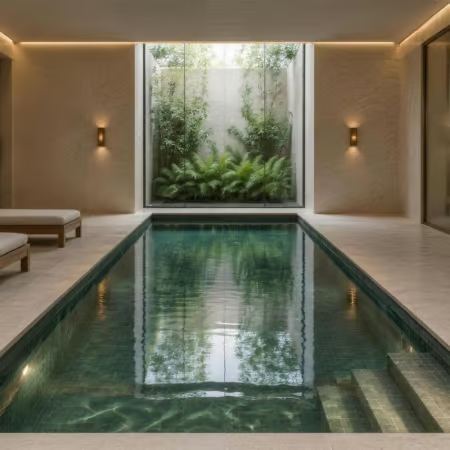
Stone is perhaps the most enduring example. Limestone, in particular, develops a remarkable depth of character over time. Its relatively soft surface absorbs the oils from daily contact, the effects of humidity and light, and the gentle abrasion of movement, building up a tone and lustre that no newly quarried slab can possess. Marble, similarly, rewards long ownership — the veining becomes more legible as the surface polishes with use, and the cooler, harder areas of calcite begin to contrast more richly with the warmer dolomitic bands. Sourcing reclaimed stone — whether eighteenth-century French limestone flags or Victorian encaustic tiles recovered from architectural salvage — means arriving at a project with patina already earned.
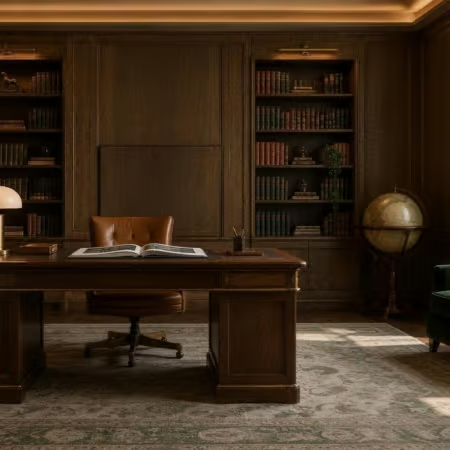
Timber treated with oils or natural waxes rather than plastic lacquers will mellow in colour and soften in texture across decades of use. Aged oak darkens to a warm, tobacco-brown depth that no stain can convincingly imitate. Wide-plank elm, American black walnut, and European white oak all reward this approach, their grain becoming more pronounced as the surface accumulates a gentle sheen from foot traffic and careful maintenance.
Metals offer perhaps the most dramatic transformations. Unlacquered brass begins with a bright, almost brash warmth and slowly deepens into rich, complex golds and ambers — developing a patina entirely shaped by where it is placed and how it is handled. Bronze hardware evolves similarly, often achieving a depth of tone within a few years that lends even a newly finished room a sense of quiet seniority. As House & Garden notes, many of today’s most thoughtful interiors actively specify aged brass and antique bronze fittings — not as a stylistic affectation, but as a deliberate acknowledgement that the finest things take time to reveal themselves fully.
Upholstery and Fabric: Embracing Wear
The same logic that governs stone and metal applies with equal force to upholstery and soft furnishings — though the timescale is compressed, and the changes are often more immediately perceptible. The right choice of fabric or leather does not merely endure use: it is transformed by it.
Full-grain leather is the canonical example. Unlike corrected or pigment-coated hides, which are treated to achieve a uniform, machine-perfect surface, full-grain leather retains all the natural markings of the animal — the subtle variations in texture, the faint imperfections that speak to its origins. With use, the surface softens, the colour deepens unevenly in the most-handled areas, and a lustrous burnish develops that no factory process can replicate. Business of Home has documented how leather-clad furniture and architectural elements acquire exactly this quality over time — a buttery depth and warmth that make pieces more beautiful in their tenth year than in their first.
Vegetable-tanned leathers, produced using traditional tannin processes rather than modern chromium methods, are particularly well-suited to this kind of graceful ageing. British tanneries with centuries of practice behind them still produce hides of this quality, and their products are increasingly sought out by designers working on commissions where longevity and authenticity are paramount.
Among woven textiles, heavy linens, wool velvets, and hand-knotted silk rugs reward long ownership in similar ways. Linen softens considerably with repeated laundering and use, losing any initial stiffness and acquiring a relaxed drape that synthetic alternatives can never achieve. Wool velvets, gently flattened in the areas of most contact, develop a natural variation in pile height that reads as depth and richness rather than wear. The faded silk of an antique Sultanabad rug, its colours bleached by decades of light to a muted, harmonious palette, is more sought-after today than it was when new — its very fading an index of quality and age.
In our experience working with clients on principal residences and country houses, the decision to invest in materials of this calibre often requires a shift in perspective — from seeing a home as a finished object to understanding it as something that continues to develop and improve across the years of occupation.
Heritage and Modernity: Balancing Patina in Design
The relationship between patina and place is nowhere more acute than in the UK’s stock of historic residential properties. Period houses — whether a Grade I listed Georgian townhouse in Belgravia, a Victorian villa in Kensington, or a Jacobean manor in the Home Counties — carry within their fabric a material history that is both irreplaceable and deeply meaningful. The approach a designer takes to these surfaces defines the character of the finished project far more than any new element introduced.
In practice, this means treating original finishes with great care and considerable restraint. Aged oak panelling, original flagstone floors worn smooth by centuries of footfall, hand-applied lime plasters with their subtle undulations — these are not imperfections to be corrected but qualities to be respected and, where possible, preserved. The Abbey Group, specialists in antique furniture restoration, note that in the world of period objects, few qualities are as prized as patina — the soft sheen and warm tone that accumulates over decades of careful use. The same principle applies to historic architecture: stripping or over-restoring original fabric rarely improves it, and often destroys precisely the quality that gives the building its character.
Where new work must be introduced — an extension, a new kitchen fitting, a contemporary bathroom set within a period shell — the material choices become critical. UK planning authorities and conservation officers will typically require that new interventions do not detract from the established character of the building or its setting. This is not merely a regulatory constraint: it is sound design thinking. Selecting materials that will weather in step with the existing fabric — a limestone that will silver gently to complement original stonework, a new timber floor in a species that mellows to a compatible tone — is the hallmark of work that will look right in twenty years, not just on the day of completion.
In contemporary projects where there is no historic fabric to reference, patina can be introduced deliberately — through the selection of reclaimed materials, the specification of living finishes, or the commissioning of artisan-made elements that carry the character of hand manufacture. The result is an interior that feels grounded rather than merely assembled, possessing a sense of depth that purely new materials rarely achieve.
The UHNW Perspective: Longevity and Legacy
For those who approach their homes as long-term investments in quality of life — and, in many cases, as assets intended to pass through generations — the case for materials that improve with age is both practical and philosophical. The finest finishes are not those that resist time: they are those that are shaped by it into something richer than they began.
The Oblist, writing on aged finishes in luxury furniture, describes patina as the gentle erosion of time itself — and observes that it has become the most coveted finish in a world otherwise saturated with factory-perfect newness. For UHNW individuals who prize exclusivity above almost everything else, this observation carries particular force. A patina is, by definition, singular. The way a specific limestone floor ages in a specific London house — affected by its orientation, its microclimate, the particular habits of its occupants — will never be reproduced elsewhere. It is an entirely individual finish, achieved without artifice.
There is also a practical dimension to this conversation that is worth addressing directly. Valet Magazine has observed that authentic patina offers no shortcuts — it is earned, unpredictable, and impossible to convincingly replicate. This is precisely what makes it valuable. Trendy finishes that look striking on completion often appear tired within a decade; the oak-and-brass combination that seemed novel in a certain year becomes dated in the next. Materials chosen for their capacity to age gracefully sidestep this problem entirely, becoming more rather than less appropriate as the years pass.
The designer’s role, in this context, extends beyond specification. It involves preparing clients for the evolution of their interior — explaining, for instance, that the living finishes they have chosen will develop their character through daily use, and that this development is the point, not a limitation. A bronze door handle that has been touched daily for five years carries something that no new fitting can — it tells the story of the house and the people within it.
The projects we undertake at Janine Stone & Co. frequently involve materials and commissions of exactly this nature — chosen not for immediate impact alone, but for the depth and distinction they will bring to a home across decades of ownership. Janine Stone & Co. works with clients from acquisition through to completed home on some of the UK’s most complex and considered residential projects; if you are building or renovating a property and wish to discuss a brief that takes the long view, we would be delighted to hear from you.